
Demand Generation
Why Many Companies Fail at Generating B2B Leads
It feels like everything is happening. And yet, when it's time to look at the pipeline, the reality is different. Opportunities don't show up, or they show up in volume, but without real conversion potential. There is activity, there is movement, there is investment, but growth still doesn't follow.
This is where frustration sets in. The feeling that the company is doing everything it's supposed to do, and still, results don't come. And the question that inevitably arises is always the same: why isn't this working?
In most cases, the first reaction is to assume the problem lies in the channels. More ads, more LinkedIn, more webinars, more outbound. But that's rarely where the real bottleneck is. The problem runs deeper.
B2B lead generation is rarely a problem of quantity. It's a problem of quality, timing, and, above all, strategy. Companies that fail rarely fail due to lack of effort — they fail because they are trying to solve the wrong problem.
Lead Generation vs. Demand Generation
Here's a classic confusion: treating lead generation and demand generation as if they were exactly the same thing. They're not.
Lead generation is the process of capturing contacts from people who are already looking for solutions like yours. There is intent, there is demand, and the goal is to convert that interest into a sales opportunity.
Demand generation, on the other hand, happens before that. It's about creating awareness and relevance among companies that have not yet fully recognized the problem or are not yet in an active buying moment.
Many B2B companies try to do lead generation without having done the demand generation work first. It's like trying to fish in an empty lake.
B2B demand generation is what creates fertile ground. Without it, your lead capture campaigns will always underperform.
The 5 Most Common Mistakes
1. Lack of clarity about the ideal customer — If you don't know exactly who you want to attract, you're communicating to everyone, and in practice, resonating with no one.
2. Generic content — Many B2B websites are still filled with generic content, trend articles, or shallow lists. Your ideal customer isn't looking for "nice" content — they're looking for answers to real, urgent problems.
3. No clarity in the value proposition — If someone lands on your website and can't understand in 5 seconds what you do and why you're different, you'll lose them.
4. Over-reliance on cold leads — The highest-converting opportunities usually come from relationships, referrals, strategic partnerships, and authority-building content, not just forms and ads.
5. Funnel misaligned with the buying journey — A common mistake is trying to sell too early. Each funnel stage requires a different message and level of maturity.
What Actually Works to Generate B2B Customers
Generating customers in B2B doesn't depend on more volume — it depends on more relevance and consistency. Five elements make the real difference:
- Clearly defined ICP — industry, company size, main pain point, budget, and decision-maker.
- Pain-driven content — address real problems, not generic topics.
- Strategic outbound — email, LinkedIn, and direct outreach with personalization and context.
- Authority building — case studies, proprietary data, and insights that build trust.
- Opportunity nurturing — most buyers don't convert on the first interaction, so follow-up is essential.
What Works Right Now
The approaches with the biggest impact on B2B lead generation today:
- Data-driven content — original studies, benchmarks, research
- Personalized outbound — messaging that shows you've done your homework
- Strategic partnerships — embedding yourself in ecosystems where your customer already is
- Small, focused events — better 10 right people than 100 random ones
B2B lead generation rarely fails due to lack of activity. It fails due to a lack of alignment between demand, messaging, and the sales process. What separates companies that generate predictable pipeline from those that rely on occasional spikes isn't the volume of effort — it's the ability to turn relevance into demand and demand into revenue.
More articles
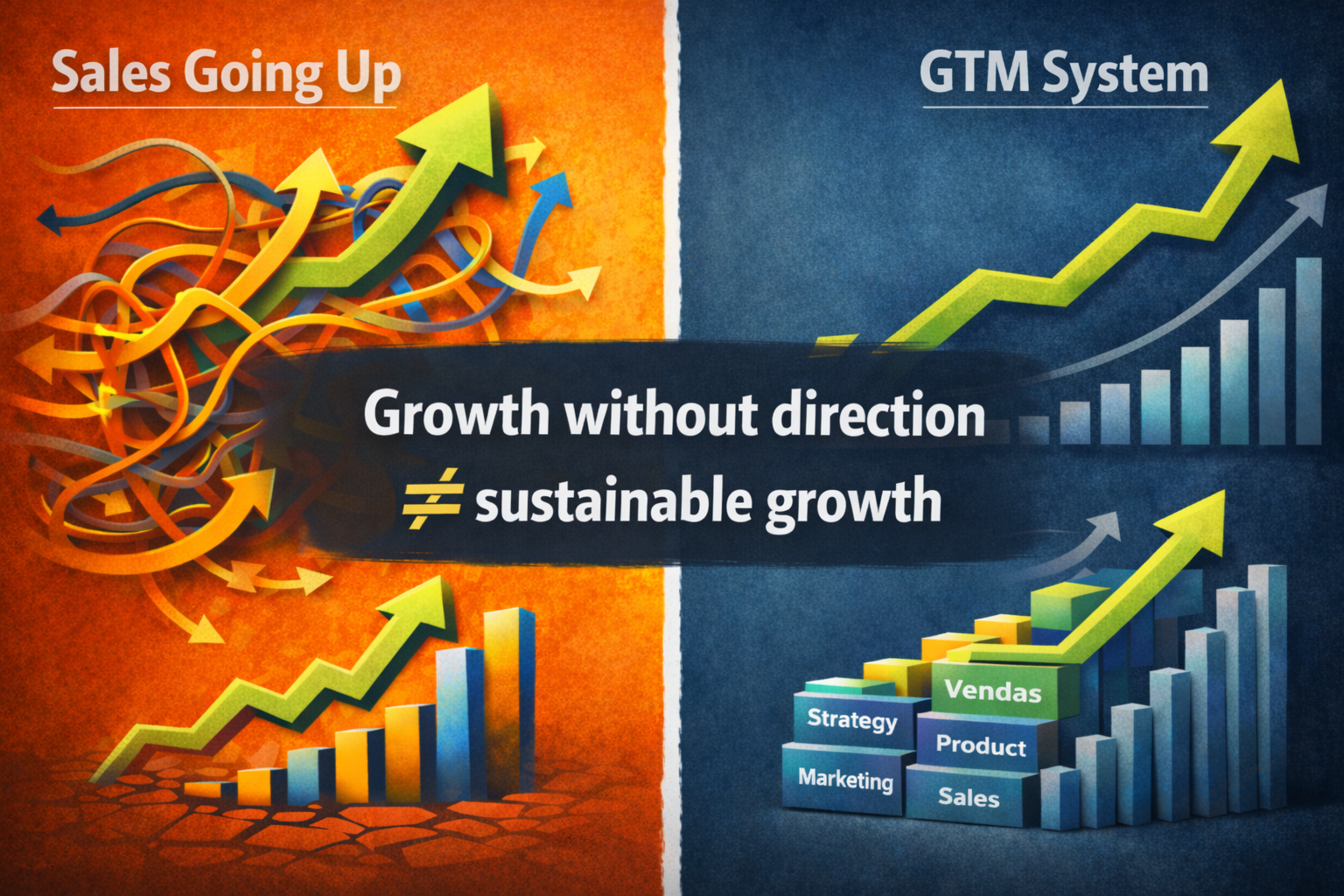
The Problem of Growing Without a Go-To-Market Strategy
Growing without a GTM strategy is like building a house without a blueprint — you might end up with a roof, but the walls will be crooked.

Signs That Your Company Needs a Go-To-Market Strategy
When product, marketing, and sales are not aligned, growth stops being predictable. Here are the five signals to watch for.
Because Many B2B Companies Have a Pipeline… but Lack Growth
A full pipeline doesn't mean growth. It often just means activity. Here's the framework we use to tell the difference.