
GTM Strategy
Signs That Your Company Needs a Go-To-Market Strategy

There are moments when a company seems to be doing everything right. The product is solid. The team is capable. There is effort across marketing, sales, and operations. And yet, growth doesn't happen.
Sales cycles take too long. The pipeline isn't predictable. Marketing generates activity, but not revenue.
This is usually where the real question emerges: "Is the problem the product… or the way it's being taken to market?" In most cases, the bottleneck isn't the offer. It's the absence of a clear Go-To-Market strategy.
The Symptom Is Rarely Just "Lack of Sales"
When a company doesn't have a defined GTM strategy, the signals show up across multiple areas at once. On the surface, they look like isolated problems. In reality, they're part of the same system.
It's common to find teams where marketing generates leads that sales rejects, sales can't clearly explain the positioning, the website gets traffic but doesn't convert, the founder is still the main salesperson, and acquisition channels keep changing.
When this happens, the problem is rarely execution. It's a lack of strategic direction.
Signal 1: No One Explains the Value Proposition the Same Way
Ask five people in the company: "what do we do and for whom?" If you get five different answers, that reveals a lack of positioning. Without a clear narrative, the company loses consistency across marketing, sales, website, outbound, and commercial proposals.
Signal 2: There Is Activity, but No Predictability
Campaigns are running, outbound is active, meetings are being booked, proposals are being sent — but growth remains unpredictable. This is a classic sign of a missing GTM strategy, because growth happens when there is alignment between ICP, messaging, channel, and sales process. Without that, there is movement, but no system.
Signal 3: Marketing and Sales Are Working in Different Directions
Marketing believes it is generating demand. Sales believes the leads are low quality. Each team measures success differently. The result: internal friction, misalignment, and lost revenue. A Go-To-Market strategy exists precisely to align these two functions around the same ideal customer, value proposition, and revenue objective.
Signal 4: They Don't Know Where to Invest to Grow
Should you invest in LinkedIn, outbound, SEO, paid ads, or partnerships? When this decision isn't clear, it usually means the ICP isn't well defined yet — channel selection shouldn't start with the channel, it should start with the customer.
Signal 5: Growth Exists, but It's Not Sustainable
Some companies grow, but with CAC that's too high, dependent on two or three large clients, or too reliant on the founder to close deals. That's not scale — that's operational fragility.
The Real Insight
In most cases, companies don't have a sales problem. They have a GTM problem. Sales simply makes the problem visible. What separates companies that grow consistently from those that stagnate isn't just the quality of the product — it's the ability to turn supply into demand and demand into predictable revenue. That's what a Go-To-Market strategy solves.
More articles
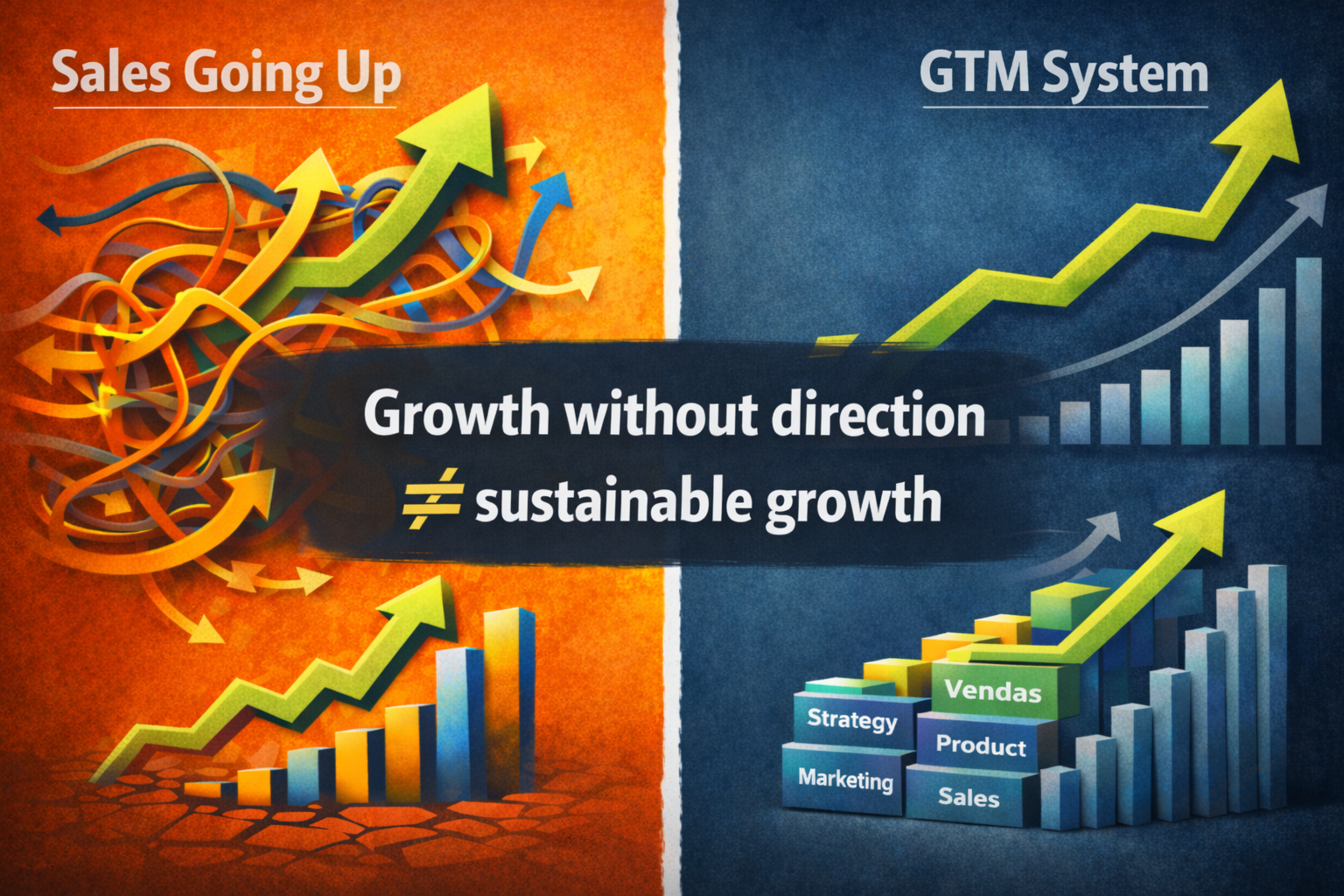
The Problem of Growing Without a Go-To-Market Strategy
Growing without a GTM strategy is like building a house without a blueprint — you might end up with a roof, but the walls will be crooked.
Why Many Companies Fail at Generating B2B Leads
B2B lead generation rarely fails due to lack of activity. It fails due to a lack of alignment between demand, messaging, and the sales process.
Because Many B2B Companies Have a Pipeline… but Lack Growth
A full pipeline doesn't mean growth. It often just means activity. Here's the framework we use to tell the difference.